supply and prices
32 parliamentarians urge Prime Minister to treat timber supply as national security issue
A cross-party letter backing Confor's Timber Security is National Security campaign sets out five measures, from a Cabinet Office taskforce to Industrial Strategy recognition for sawmilling and engineered timber.
A group of 32 MPs and members of the House of Lords has written to Prime Minister Andy Burnham asking the Government to treat timber as a strategically important national resource, the Confederation of Forest Industries (Confor) said on 10 November.
The letter backs Confor's Timber Security is National Security campaign and sets out five measures for ministers. Confor, a membership organisation for forestry and wood-using businesses, said it was the campaign's most significant parliamentary intervention to date.
Confor said the UK imports more than 80% of the timber it uses. It also described the UK as the world's second largest net importer after China, although the latest official edition of Forestry Statistics, published by Forest Research, ranks the UK third largest net importer of forest products for 2024.
Ben Lake MP, Chair of the APPG (All-Party Parliamentary Group) on Forestry and Timber Security, said: "This is an issue that deserves far greater attention across Government. We need cross-departmental action and a clear, coordinated strategy".
The five measures
The letter opens by saying a sustainable future timber supply is vital for national security and economic resilience, and asks the Government to:
- include timber supply metrics within the National Security Risk Assessment;
- set up a cross-government Timber Security Taskforce reporting to the Cabinet Office, coordinating Defra, HM Treasury, the Department for Business and Trade and the Ministry of Housing, Communities and Local Government;
- provide Treasury-backed long-term certainty for productive woodland investment;
- recognise sawmilling, wood processing and engineered timber production within the Industrial Strategy as strategically important sectors; and
- commit to annual public reporting on timber import dependency and domestic capacity.
The signatories argue that forestry operates on decades-long investment cycles, so long-term policy and funding certainty is needed to unlock private investment. They say a stronger domestic supply would support housing delivery and modern methods of construction. The letter closes with the words "We urge the Government to act."
Lillian Jones MP, Chair of the APPG on the Wood Panel Industry, said: "Strengthening our domestic timber supply is not simply about planting more trees. It is about supporting the industries that turn that resource into the products our economy depends upon."
Jones added that there was an opportunity to recognise wood processing as a strategic manufacturing sector.
Stuart Goodall, Chief Executive of Confor, said timber security must become a national priority. He said the UK had the land, expertise, businesses, potential investment and workforce to produce much more of the resource domestically, and described the measures in the letter as practical, achievable steps to which the Government now needed to respond.
Signatories listed by Confor include Dr Zubir Ahmed MP, Dr Scott Arthur MP, Richard Baker MP, Lord Cameron of Dillington, Gregory Campbell MP, Irene Campbell MP, Kirsteen Sillivan MP, Mohammed Yasin MP and Baroness Young of Old Scone.
The official figures
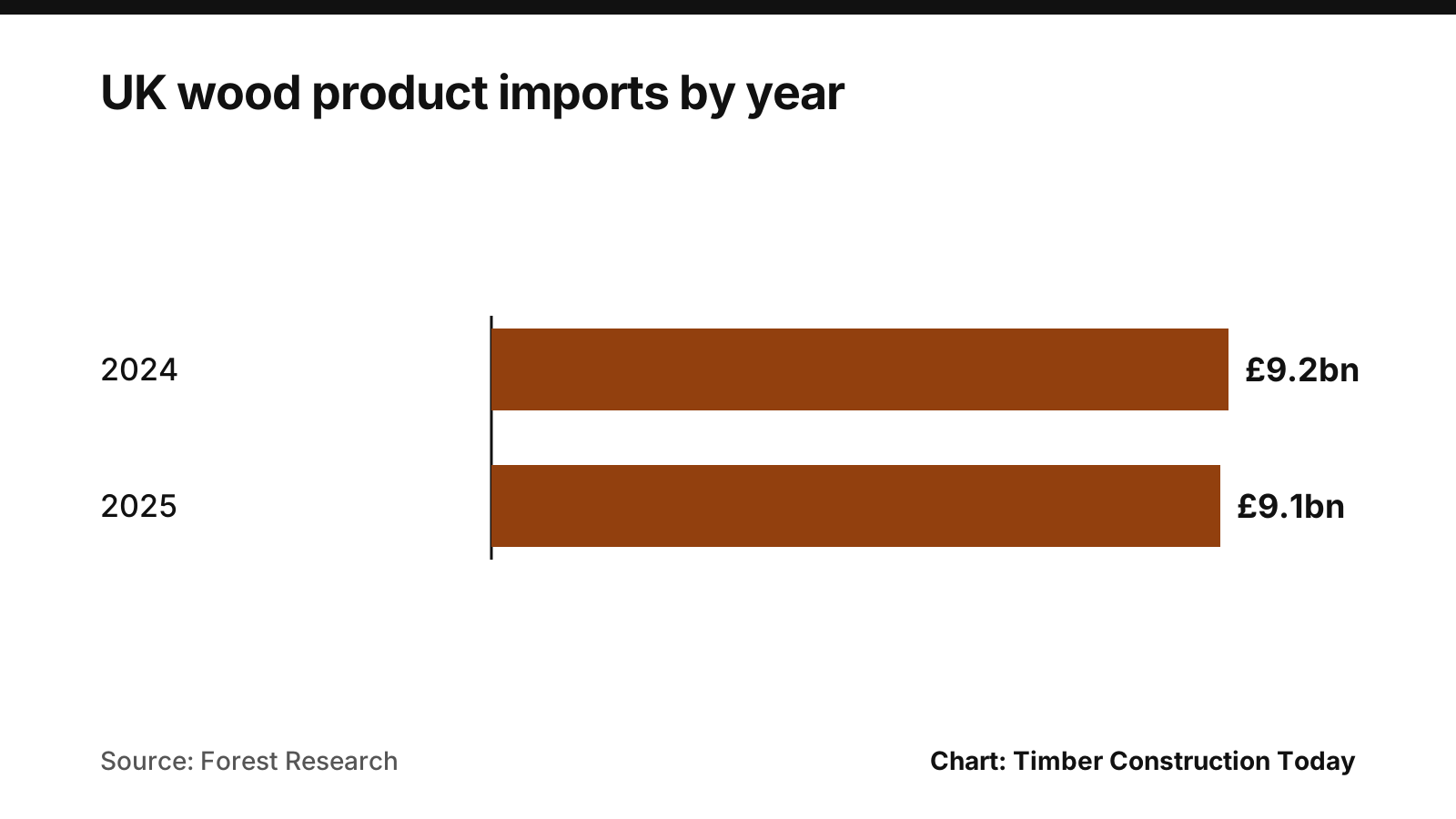
Forest Research, the research agency of the Forestry Commission, valued wood product imports into the UK at £9.2bn in 2024 and £9.1bn in 2025. Apparent consumption of wood rose from 48.5 million cubic metres in 2024 to 49.1 million cubic metres wood raw material equivalent underbark in 2025.
| Year | UK wood product imports |
|---|---|
| 2024 | £9.2bn |
| 2025 | £9.1bn |
The UK imported 6.3 million cubic metres of sawnwood in 2024, with sawn softwood and several other product groups coming mainly from EU countries, according to Forest Research. In 2025, 10.4 million green tonnes of UK roundwood were delivered to primary wood processors and others.
Forest Research's 2025 edition had ranked the UK the second-largest net importer of forest products in 2023, with net imports of US$8.0bn, behind China on US$29.2bn. The agency describes the UK as one of the least densely forested countries in Europe, with woodland area estimated at 3.30 million hectares at 31 March 2026.
The campaign
Confor launched the campaign on 18 March 2026, built on a report titled Timber: An Issue of National Security and Economic Resilience, which was launched in the House of Commons. At the launch Confor called for timber to be recognised as a strategic national material comparable to food and energy security, and said the forestry and wood supply chain supports more than 90,000 jobs.
Since then, Confor said, the campaign has engaged more than 75 MPs, attracted hundreds of signatures to its public petition, and included a policy briefing, industry mobilisation, digital campaigning and a series of videos. It has worked through the APPG on Forestry and Timber Security and the APPG on the Wood Panel Industry.
Confor said it is now asking the Government to respond positively to the proposals and to work with parliamentarians and industry on a long-term approach to securing the UK's timber supply.
On the record: Forestry Commission, Ministry of Housing, Communities and Local Government
Sources
- Confor (opens in a new tab) (accessed 2026-11-10)
- Confor (opens in a new tab) (accessed 2026-11-10)
- Confor (opens in a new tab) (accessed 2026-11-10)
- Forest Research (research agency of the Forestry Commission) (opens in a new tab) (accessed 2026-11-10)
- Forest Research (research agency of the Forestry Commission) (opens in a new tab) (accessed 2026-11-10)
- Forest Research (research agency of the Forestry Commission) (opens in a new tab) (accessed 2026-11-10)
This story was researched from the primary sources above and checked against them before publication. Spotted an error? Tell us and we will correct it promptly.